Bryce M. Paschal
Education
- Postdoc, The Scripps Research Institute, La Jolla, CA
- BA, University of North Carolina, Chapel Hill, NC
- PhD, University of Massachusetts Medical School, MA
Primary Appointment
- Professor, Biochemistry and Molecular Genetics
Contact
- Phone: 434-243-6521
- Email: bmp2h@virginia.edu
- Website: http://www.healthsystem.virginia.edu/internet/cellsignaling/bpaschal.cfm
Research Interest(s)
Nuclear Transport, Signaling, and Cancer
Research Description
My laboratory studies how nuclear transport and signal transduction control the
compartmentalization and activity of transcription factors, particularly in the
context of prostate cancer. A major focus of these studies is the androgen receptor
(AR), a steroid hormone receptor that is critical for prostate cell growth. Translocation
of AR through the nuclear pore complex (NPC) relies on features common to most
nuclear transport pathways: (i) the use of nuclear import or export signals; (ii)
the recognition of these signals by receptors that mediate translocation through
the NPC; and (iii) RanGTPase-dependent assembly and disassembly of transport complexes.
The signals that specify nuclear import and export of AR, the receptors that mediate
AR translocation, and the role of the RanGTPase in AR transport are all under
investigation in my laboratory. Nuclear export would be expected to provide an
effective mechanism for terminating the transcriptional response to androgen,
however, we have recently found that AR translocation to the cytoplasm is important
for its activity in the nucleus. This apparent paradox may reflect an undefined
step in AR maturation, or crosstalk between AR and signal transduction pathways
in the cytoplasm.
AR is the target of multiple kinases, and we have generated phosphosite antibodies
to study the pathways and functions of phospho-regulation. In the course of
these studies we discovered a novel mechanism for loading protein phosphatase
2A (PP2A) onto AR. The loading mechanism requires small t antigen, a product
encoded by SV40 that binds and alters the structure of a PP2A subunit. Current
experiments are aimed at defining the structural basis of the PP2A loading reaction,
as well as determining the cellular factors that mediate PP2A loading onto AR
in untransformed cells.
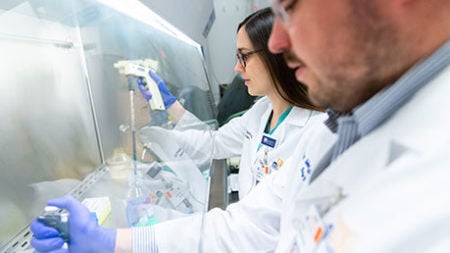
While biochemical analysis is the cornerstone of our nuclear transport and
signal transduction studies, we also employ cell biological approaches including
microinjection, fluorescence microscopy and real-time imaging in live cells,
and animal models of tumorigenesis. Our studies benefit from ongoing collaborations
with groups that specialize in mass spectrometry, pathology, and prostate cancer.
Selected Publications
- Gioeli D, Black B, Gordon V, Spencer A, Kesler C, Eblen S, Paschal B, Weber M. Stress kinase signaling regulates androgen receptor phosphorylation, transcription, and localization. Molecular endocrinology (Baltimore, Md.). 2005;20(3): 503-15. PMID: 16282370
- Pemberton L, Paschal B. Scientists share nuclear secrets at Jekyll Island. Traffic (Copenhagen, Denmark). 2006;7(6): 751-60. PMID: 16637892
- Yang C, Xin H, Kelley J, Spencer A, Brautigan D, Paschal B. Ligand binding to the androgen receptor induces conformational changes that regulate phosphatase interactions. Molecular and cellular biology. 2007;27(9): 3390-404. PMID: 17325038 | PMCID: PMC1899975
- Kesler C, Gioeli D, Conaway M, Weber M, Paschal B. Subcellular localization modulates activation function 1 domain phosphorylation in the androgen receptor. Molecular endocrinology (Baltimore, Md.). 2007;21(9): 2071-84. PMID: 17579212
- Kelley J, Paschal B. Hyperosmotic stress signaling to the nucleus disrupts the Ran gradient and the production of RanGTP. Molecular biology of the cell. 2007;18(11): 4365-76. PMID: 17761537 | PMCID: PMC2043571
- Shank L, Kelley J, Gioeli D, Yang C, Spencer A, Allison L, Paschal B. Activation of the DNA-dependent protein kinase stimulates nuclear export of the androgen receptor in vitro. The Journal of biological chemistry. 2008;283(16): 10568-80. PMID: 18270197
- Kaikkonen S, Jääskeläinen T, Karvonen U, Rytinki M, Makkonen H, Gioeli D, Paschal B, Palvimo J. SUMO-specific protease 1 (SENP1) reverses the hormone-augmented SUMOylation of androgen receptor and modulates gene responses in prostate cancer cells. Molecular endocrinology (Baltimore, Md.). 2009;23(3): 292-307. PMID: 19116244
- Galgano M, Conaway M, Spencer A, Paschal B, Frierson H. PRK1 distribution in normal tissues and carcinomas: overexpression and activation in ovarian serous carcinoma. Human pathology. 2009;40(10): 1434-40. PMID: 19427017 | PMCID: PMC2744839
- Ni L, Yang C, Gioeli D, Frierson H, Toft D, Paschal B. FKBP51 promotes assembly of the Hsp90 chaperone complex and regulates androgen receptor signaling in prostate cancer cells. Molecular and cellular biology. 2010;30(5): 1243-53. PMID: 20048054 | PMCID: PMC2820886
- Kelley J, Talley A, Spencer A, Gioeli D, Paschal B. Karyopherin alpha7 (KPNA7), a divergent member of the importin alpha family of nuclear import receptors. BMC cell biology. 2010;11 63. PMID: 20701745 | PMCID: PMC2929220
- Braddock S, Ardinger H, Yang C, Paschal B, Hall B. Petty syndrome and Fontaine-Farriaux syndrome: Delineation of a single syndrome. American journal of medical genetics. Part A. 2010;152(7): 1718-23. PMID: 20583180
- Gioeli D, Paschal B. Post-translational modification of the androgen receptor. Molecular and cellular endocrinology. 2011;352(1): 70-8. PMID: 21820033